-
 Nicola
Calming Pregnancy Yoga

Yoga offers huge benefits for pregnancy – from calming and restoring you in the early days, maintaining mobility and dealing with common symptoms in the middle period, to preparing you mentally and physically for the birth.
Prenatal yoga can do all this, it’s powerful stuff! But it’s important to understand where pregnancy yoga differs from all the other general styles yoga and how to adapt your practice.
Yoga during pregnancy is not a time to train for improvement or aesthetics; it’s about learning to move with your rapidly changing body, new centre of gravity and creating a combination of softness and strength. Regular yoga is about raising the energy upwards, whereas pregnancy yoga is all about being more grounded and centred.
If you have a regular pre-pregnancy yoga practice, read the following tips to safely adjust your approach for the benefit of you and baby.Things to incorporate into your pregnancy yoga practice
- Lie on the left in savasana (relaxation) and roll to the left. Favour the left side also when you sleep (this is to avoid pressing on the large vena cava vein and also helps optimal position of the baby)
- Shorten the length of your stride in familiar standing poses such as warriors or triangle.
- Make sure you include specific pelvic floor exercises to aid delivery and recovery
- Support yourself with a blanket and a couple of cushions during seated and floor poses and relaxation
- Breathe in through the nose and out through the mouth (rather than in and out of the nose as in regular yoga). You’ll find this is a wonderfully calming and centering breath and the feeling of release on the out breath can also be a boon during labour!
- Step in and out of poses (rather than jumping as in Astanga / Vinyasa styles)
- Move legs regularly between standing poses and avoid holding poses for too long
- Take it slowly, easing between poses and have a bottle of water to hand
Things to avoid
- Lying on your front and compressing your baby bump
- Deep twists across your body or any abdominal work (gentle open twists are OK)
- Holding your breath
- Lying flat on your back post 25 weeks (or earlier if you feel short of breath or uncomfortable)
- Strong backbends such as camel, upward bow.
It’s also recommended to avoid any physical (asana) practice in the first 14 weeks of pregnancy. Whilst this may seem tough or counter-intuitive for life-long-yoginis it’s all about giving your body time and space to establish the pregnancy and placenta. Focus instead on gentle breathing and look forward to rediscovering your Trimester Two yoga practice with your bump.

Baddakonasana – breathing deeply into the belly to send oxygen to you and baby.

Crescent lunge to release the hips and open the heart space.

Poses which open the chest and shoulders are beneficial, as this helps counter the shoulder-rounding effects of extra weight at the bottom of your spine. Lifting the chest can also help relieve heartburn.

Try warrior 3 to maintain strength in your legs and practice your balance, and you can still enjoy the power of warrior 2 from trimester 2 onwards – seen here in Worcester class.
Kate of Redkiteyoga has been teaching vinyasa, a flowing, upbeat style of yoga, since 2009. As part of her own journey to become a mother, she trained in Pre and Post Natal Yoga and Yoga for Birth. For details see www.redkiteyoga.co.uk or tweet @redkiteyoga -
 Nicola
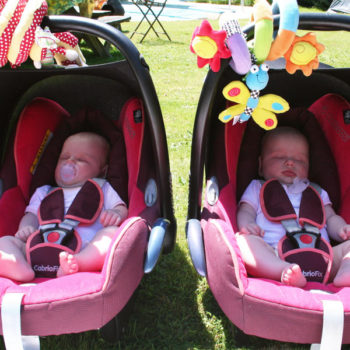
Ten facts about twins
Exciting but slightly daunting seems to be the general reaction to a twin pregnancy! Make sure your pregnancy diet contains plenty of protein, calcium, iron, folic acid and Vitamin B12 with lots of fresh fruit and vegetables and extra whole-grains to keep your blood sugar stable. Aim for at least eight large glasses of water every day – flavour your hydration, with mint, fruit or cucumber.
Exercise can be more of a challenge if you’re pregnant with twins, but don’t give up – staying fit will improve your strength and stamina. Wearing supportive FittaMamma fitnesswear will help lift and support the extra weight of a twin pregnancy even if walking is all you can manage as your double baby bump gets bigger. Most importantly, don’t neglect your pelvic floor exercises, the additional pressure on your pelvic floor muscles makes it even more essential to ‘lift and squeeze’ regularly every day.- Worldwide there are at least 125 million living multiples, of which one-third are identical.
- Twins are more likely to be left-handed. Up to 22% of twins are left-handed compared with less than 10% in the general population.
- Many twins develop their own language when they first learn to speak. Cryptophasia is common in up to 40% of twins although their private language generally disappears as they learn to communicate more widely.
- ‘Mirror Image’ twins account for about 25% of identical twins. Their hair falls in opposite directions, they have mirror image fingerprints and if one is right handed the other is left handed. More rarely, mirror image twins have mirrored internal organs with one twin having their heart on the right-hand side.
- The highest incidence of twin births worldwide is in Nigeria, with some sources attributing this to a high consumption of yams. There is some basis of fact behind this: yams apparently contain phytoestrogen, which can cause multiple eggs to be released at ovulation.
- A study by the University of Padova revealed that twins in the womb reach out and touch each other more frequently than they touch their own bodies, making distinct and gentle gestures to their twin sibling.
- The average duration of a regular pregnancy is 40 weeks. In a twin pregnancy this decreases to an average of 37 weeks.
- The number of twin births in the UK is increasing, largely as a result of more successful IVF treatments. Twins and triplets account for around 3% of babies born in the UK – you’re 20 times more likely to have twins as a result of IVF than via natural conception.
- Your chances of a twin pregnancy become more likely with age, with the odds increasing significantly after the age of 35.
- Our favourite ‘twin fact’ is the Russian father who was presented to the empress of Russia in 1853: he had been married twice and between his two wives had 72 children including 4 sets of quads, 8 sets of triplets and 8 sets of twins! Ouch.
-
 Nicola
"I’m Blooming!"

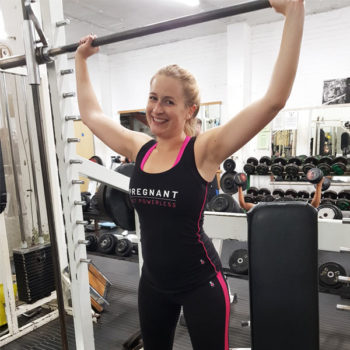
FittaMamma Founder Alexandra McCabe is now in her second trimester…
It’s taken a while but I’m beginning to get used to being pregnant! I’ve lived and breathed pregnancy for several years now, researching different exercises for pregnant women, following pregnancy workouts to make sure they work for every trimester and trying out recipes that will give an instant hit of essential pregnancy nutrients.
And I’ve been wearing our maternity activewear for years. FittaMamma leggings are perfect for everyday wear, pregnant or not!
But everything feels very different now I’m actually pregnant myself!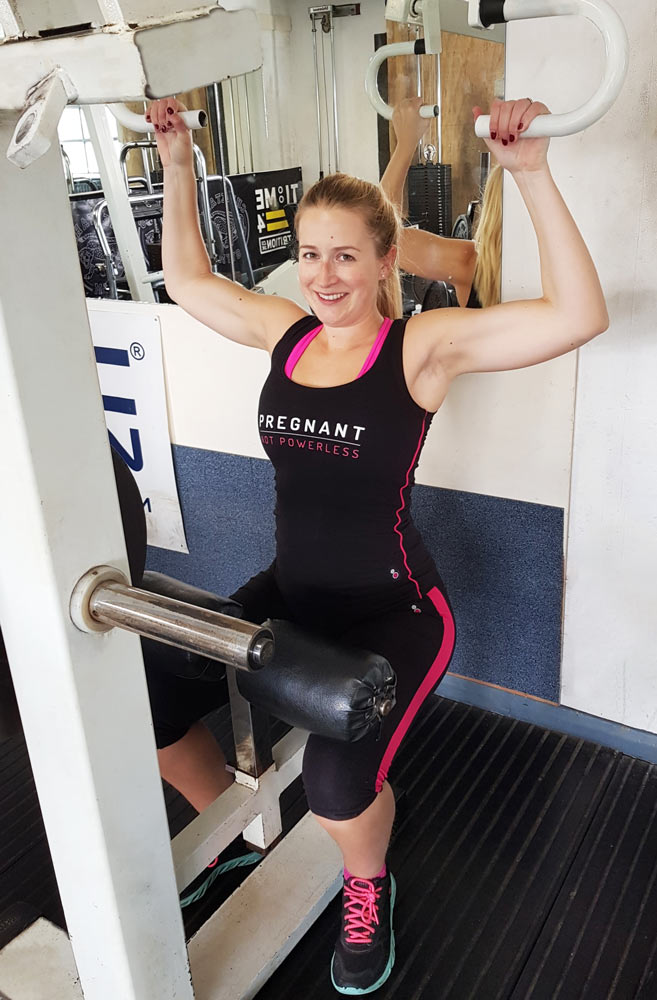
Can anything prepare you for the changes in your body during pregnancy?
How many times have I reassured our pregnant models that their baby bump is tiny when they look down at their bellies and describe themselves as ‘huge’? Now I understand how they feel! My once-flat stomach has a mind of its own and my boobs are massive, with a never-previously-experienced cleavage.
Weight training is still my ‘go to’ exercise for pregnancy. I have every intention of enrolling for a pregnancy yoga class to enjoy the benefits of relaxation and breathing techniques to prepare for labour but right now resistance training is my pregnancy preference. Combined with regular sessions on the cross-trainer or a static bike to maintain my cardio fitness, weights are fantastic for maintaining my strength and making me feel more in control of my body. I’ve slightly reduced the size of the weights but increased the number of repetitions.
I’m loving the way our maternity fitwear holds and support my baby bump. I’ve always been proud of our range but now I’m really enjoying the benefits. And, it’s not just in the gym either – what’s not to love about wearing a pregnancy workout support top to work?
My best discovery has been the latest addition to the FittaMamma shop – or, as I like to call it, my new breast friend. We’ve recently introduced a nursing sports bra (courtesy of Hot Milk) which holds my burgeoning boobs in perfect comfort. I’m looking forward to wearing it for nursing in due course!And a quick pregnancy diet update too!
Whilst the first trimester nausea has calmed down, my diet remains erratic. The smell of cooking broccoli, once my favourite ‘go to’ vegetable still makes me feel queasy. Raw veggies (especially broccoli and spinach) blended with plenty of cucumber or watermelon and apple juice has become my easy fix of essential pregnancy vitamins.
I am however, loving peanut butter.
Peanut butter on apple slices. Peanut butter on corn thins. Peanut butter with cheese. Chicken cooked with peanut butter. Peanut butter in a smoothie. Peanut butter on porridge. Ok… peanut butter on a spoon straight out of the jar. I console myself that I only buy crunchy, sugar free peanut butter and it DOES contain protein, fibre, heart-healthy monounsaturated fat and a good burst of potassium which helps lower the risk of high blood pressure during pregnancy.
I can’t eat after 7.30 in the evening – which is probably better for my digestive system but interferes with my early evening workout. But if I happen to wake up in the middle of the night, I can’t resist a sneaky bowl of bran flakes.
Nevertheless, pregnancy remains an exciting new adventure. I’m looking forward to the much-vaunted thick glossy hair and extra peachy skin. And my baby!
I am so proud to be able to participate in the ‘Pregnant Not Powerless’ campaign!
FittaMamma is leading the campaign to inspire women, motivate Mammas-to-be to stay fit during pregnancy and reduce the levels of negativity towards the incredible, inspirational women who choose an active and healthy pregnancy.
Join us on social media @FittaMamma and use the hashtag #PregnantNotPowerless. Share your active pregnancy images and join our gallery of inspirational FittaMammas.Let’s work together to create social change. Let’s encourage women to give their children the best possible start in life.
-
 Nicola
Double the Power
Elin and Jakobina are identical twin sisters who run their own CrossFit box in Iceland. They share their story and why they are proud to support our ‘Pregnant Not Powerless’ campaign.
Identical twin sisters, Elin and Jakobina have always been keenly involved in sports and their commitment to staying active and a healthy lifestyle remained undiminished throughout their first pregnancies (yes, they were both pregnant at the same time) and continued throughout their second pregnancies (yes, both pregnant at the same time again!).
Together with their husbands, Elin and Jakobina recently opened a new CrossFit box in Iceland called Grandi101 (CrossFit Grandi). Amongst all the regular CrossFit classes and GrandaFit – their own cardio based classes – they have developed courses especially for pregnant women and new mums. The ‘’MömmuFit’’ classes are proving to be a huge success, with every course sold out since they were launched in April.
Elin says, ‘’We are both going through our second pregnancy and we both trained up until our due date when we were expecting our first sons. For us training and pregnancy fit perfectly together provided the training is smart and the main focus is on feeling good, both during the training and afterwards.
If we need to scale down our exercises we find an appropriate alternative. Instead of push-ups we do push-ups on a box, instead of running we do cycling or rowing and so on. The feeling and energy we get after a good workout is especially important during pregnancy, both for our body and soul.
Our motto is – Happy and healthy mom equals happy and healthy baby.”Jakobina continues, ‘We believe that it’s good for every pregnant woman to do some kind of exercise, but the preferred style depends on how we trained pre-pregnancy. While taking a long walk is enough for some women, others can do heavy lifting and more intensive cardio training. We are all so different – while some women will never manage heavy lunges or box-jumps, other have no problem doing them regularly.
Women who do more intensive training during pregnancy often receive a lot of criticism from people who simply don’t know any better. We firmly believe it’s important to recognise that the woman herself is the one to judge how hard she can train, what feels good for her and when she should scale back. We don’t know any women who wouldn’t put their baby’s health first, of course baby is always the priority.’
We really hope that we can inspire other women to exercise while pregnant – it will make the pregnancy much easier and ensure faster recovery after birth.’’

At the time of writing, Elín and Jakobina both had three year old sons with another one on the way. Since writing this, Elin and Jakobina have both given birth to healthy baby boys.
Issue 4
Fittamamma Magazine > Issue 4


